White Paper: Why Many Distillation Units Waste 20–35% of The Solvent
How operators of existing distillation plants can increase their recovery rate, reduce operating costs, and identify hidden efficiency losses
The Hidden Problem with Many Distillation Plants
Many companies already have their own distillation plants and therefore assume that their solvent recovery is already optimized. In practice, however,
the reality is quite different. While modern systems can achieve recovery rates of 92–97%, many existing plants consistently operate in the 60–70% range.
The result:
- Larger volumes of waste
- Higher energy costs per liter of distillate
- Additional logistical effort
- Hidden costs that often go unnoticed
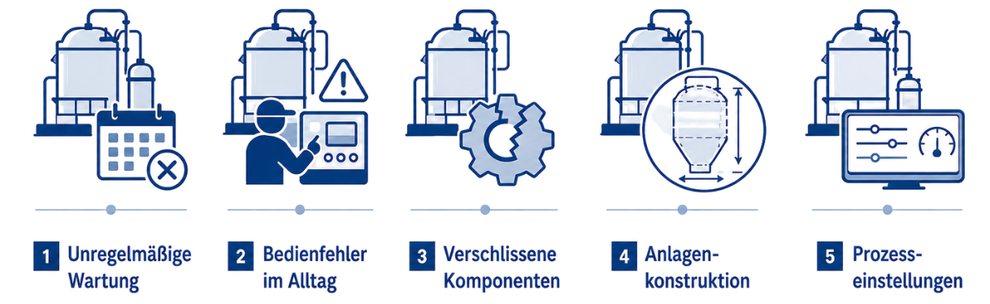
The low recycling rate is often accepted as unavoidable. However, the cause often lies not in the solvent itself, but in a combination of:
- Plant Design
- Maintenance Status
- Operation
- Process Settings
- Wear and tear
Conclusion:
Many distilleries are operating below their capacity, thereby incurring unnecessary costs.
Common Causes of Low Recovery Rates
Irregular maintenance
Many operators do not perform maintenance until problems become apparent. Typical consequences include fouled heat exchangers, reduced evaporation capacity, longer batch times, and increased energy consumption.
Operating Errors in Everyday Life
The checkpoints defined in the manual are often not carried out consistently. Typical examples include inadequate cleaning, incorrect fill levels, incorrect temperature settings, and failure to detect signs of wear. Even minor deviations can significantly affect the recovery rate.
plant design
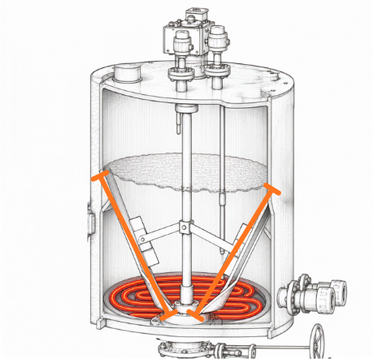
Not every distillery offers the same physical conditions for high solvent recovery. One factor that is often underestimated is the geometry of the distillation kettle. Many systems available on the market feature a conical
vessel design, which can present disadvantages, particularly in terms of heat transfer.
process settings
Many systems have few configuration options, a
low level of automation, and insufficient process analysis with customization options.
When the Investment Structure Becomes a Limiting Factor
Not every distillation plant is suitable for maximum solvent recovery. One factor that is often underestimated is the design of the distillation system itself. Many older or simpler plant designs reach their technical limits, particularly when dealing with complex solvent mixtures.
the container geometry
Many systems available on the market use conical distillation vessels. Due to their design, this configuration can lead to certain disadvantages:
- Significant energy losses during distillation
- Uneven heat distribution across the heating surfaces
- Decreasing distillation capacity as the liquid level drops
- This results in longer batch times!
In such designs, the effective heating surface is often reduced, particularly at lower fill levels. The result is a continuous drop in output during the batch.
INACCURATE TEMPERATURE MEASUREMENT
In some system designs, temperature measurement is performed with relatively low accuracy and high hysteresis.
Possible effects:
- Temperature fluctuationsof several degrees Celsius
- reduced distillation capacity
- Unstable case management
- increased foaming
- System Overflow During Critical Operating Conditions
- Difficulties in monitoring during refilling operations
Precise temperature control can be crucial for product quality and recovery rates, especially when dealing with complex solvent mixtures.
Limited process monitoring
Existing systems often provide only limited process information. Most operators have access only to basic data such as heating time, vacuum time, and batch duration.
As a result, important information is missing for
- Productivity Analyses
- Efficiency Assessments
- Root Cause Analysis for Performance Fluctuations
- Optimizing the Recovery Rate
Without reliable process data, many operational losses remain hidden.
Limited tolerance for fluctuating media
In practice, solvent mixtures are constantly changing. Typical factors that influence this include: varying solids content, different levels of contamination, water content, and process residues. Not all system designs can reliably handle such fluctuations.
Possible consequences:
- fluctuating distillate quality
- declining recovery rates
- increasing operational burden
- more frequent process interruptions
Lack of output and backlog monitoring
In simpler systems, the emptying process often takes place without active monitoring of the remaining residue.
This gives rise to risks related to:
- NC fires caused by dried-out residue on the exposed heating surfaces
- Product Losses
- unnecessarily high residual amounts
- inconsistent batch results
- additional cleaning effort
Special Challenges with Solvents Containing NC
Design differences become particularly apparent when dealing with sensitive solvent mixtures containing nitrocellulose (NC).
These media place increased demands on:
- Temperature Control
- Heat Transfer
- Process Stability
- Distribution Concept
- Plant Control
While modern plant designs can achieve high recovery rates even with such mixtures, older or less specialized systems often:
- significantly lower distillation capacities
- lower recycling rates
- longer batch times
- increased process instability
Conclusion:
Low recovery rates are not always due to maintenance or operation. In many cases, the system design itself sets the limit on achievable performance. Therefore, if recycling rates remain consistently low, it is important to evaluate not only the system’s operation but also the design parameters of the system in use.
Would you like the entire white paper, including
- Checklist of key metrics you should review regularly
- Sample Calculation, Industry Benchmark
- Case Study
- and much more.
Then feel free to download it here as a PDF—it's free and requires no additional information.
Press contact:
Renzmann GmbH
Marketing & Communications
Rebecca Wilhelm
Email: wilhelm@renzmann.com
Phone: +49 (0)6751 / 878-290
