ATEX Explosion Protection for Solvent Distillation Units and Washing Machines
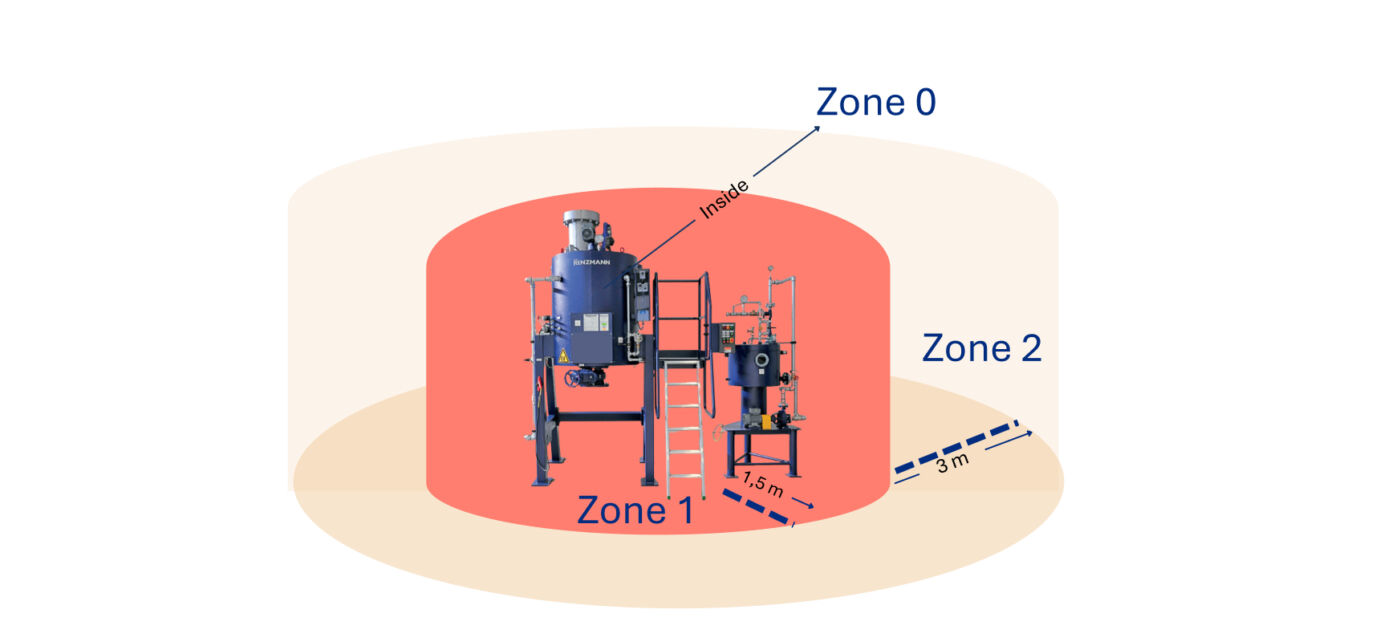
How does an "ex" atmosphere even come about?
Paints, varnishes, printing inks, and coating materials often contain flammable organic solvents, depending on the properties required by the customer. During the manufacture and processing of these products, explosive mixtures of solvent vapor and air may form, depending on the volatility of the solvents they contain. Consequently, both the manufacturers of these solvent-based products and those who process them—particularly printing companies and operators of coating or painting facilities—face the challenge of ensuring the safe operation of machinery in potentially explosive atmospheres.
After the manufacture or processing of solvent-based products, product residues or deposits remain on tools, machine parts, and production equipment, which must be cleaned. The most suitable cleaning method is usually to rinse off the surface residues with the same solvent already contained in the product. For this purpose, Renzmann offers enclosed solvent washing machines. The spraying process always creates an explosive atmosphere (= Zone 0) inside the washing machine, and—at an application temperature above the solvent’s flash point (for highly volatile solvents)—an explosive solvent vapor/air atmosphere, as well as an explosive solvent aerosol/air atmosphere (regardless of the flash point, even with low-volatility solvents).
Renzmann offers distillation systems for the treatment and recovery of both cleaning solvents and residual solvents from production. The interior of these systems always contains solvents at a temperature above their flash point; even in the case of low-volatility solvents, this is achieved by heating them above their flash point. Until the boiling point is reached, air is present above the liquid level, which is displaced by the vapors generated during the boiling process. When the residue is drained off, air flows back into the distillation kettle. The solvent vapor/air mixtures regularly form an explosive atmosphere during start-up and shutdown procedures of the distillation process (= Zone 0). For Zone 0—in this case, the interior of solvent washing machines and distillation systems—Equipment Category 1 is always required. (An explanation of zone classification and equipment categories according to ATEX can be found here).
For manufacturers of paints, varnishes, printing inks, and coating materials, as well as for printing companies, it is therefore not solely a matter of whether a machine, system, or device bears an ATEX marking. What matters is whether its explosion protection—as indicated by Category 1 on the CE label—actually matches Zone 0, which applies to the interior of the equipment.
Renzmann consistently ensures a high level of protection in its solvent distillation systems and solvent washing machines. After all, explosion protection is not just a matter of formal certification, but of protecting people, production facilities, and investments—and of the shared responsibility borne by manufacturers and operators.
ATEX: What does the operator need to be aware of?
The ATEX Occupational Safety and Health Directive 1999/92/EC, often referred to as ATEX 137, requires employers to assess explosion hazards and establish appropriate protective measures. In Germany, these requirements are specified in particular by the Hazardous Substances Ordinance and the Industrial Safety Ordinance.
This means that the operator bears a significant responsibility. Among other things, the operator must:
- Assess areas at risk of explosion and, if necessary, divide them into zones,
- determine the required equipment category,
- Take into account the explosion group and temperature class,
- select appropriate work equipment,
- verify that the labeling, documentation, and operating conditions match,
- record the results in the explosion protection document,
- Have equipment and machinery in potentially explosive atmospheres inspected by qualified personnel, the manufacturer, or authorized inspection bodies prior to commissioning and on a recurring basis
The current Hazardous Substances Ordinance defines Zone 0 as an area in which a hazardous explosive atmosphere consisting of air and flammable gases, vapors, or mists is present continuously, for long periods of time, or frequently. For a Zone 0 designated according to this classification, Category 1 equipment is generally required. In case of doubt, the ordinance stipulates that the stricter zone must be selected.
This means that operators should not settle for the general statement “ATEX-compliant.” They need a clear answer as to which part of the machine is designed for which zone and which equipment category.
ATEX in Distillation Plants – What Sets Renzmann Apart
Zone 0 in the distillation kettle: Start-up and shutdown procedures are included
In a solvent distillation plant, contaminated solvent is heated. The lower-boiling-point components evaporate, are condensed, and are then recovered as reusable solvent.
During stable distillation, a high concentration of solvent vapor can significantly reduce the oxygen content in the kettle. In vacuum systems, a large portion of the air is also extracted before distillation begins. However, one should not hastily conclude from this that the interior of the kettle should generally be classified only as Zone 1.
The following are particularly relevant:
- the heating phase
- the creation of a vacuum
- the reduction of the vacuum
- cooling
- potential air leaks
- Opening and filling the machine
During these operating phases, an explosive mixture of solvent vapor and air can form. If such processes occur during every distillation cycle—and thus several times a day—this is not merely an occasional occurrence.
This is precisely where a crucial difference lies between a safety concept interpreted as narrowly as possible from a formal standpoint and a consistent safety philosophy: regularly recurring start-up and shutdown procedures must be included in the hazard assessment.
Renzmann therefore always treats the steam-carrying interior of the distillation kettle in accordance with the high safety standards required for Zone 0. Potential ignition sources—such as agitators, sensors, or level switches—must be evaluated accordingly and designed to be suitable for their intended use.
An alternative may be an effectively monitored inerting strategy in which critical operational phases are carried out under nitrogen. However, whether this can prevent or alter a hazard zone must be demonstrated by experts for the specific plant and process. The mere possibility of supplying nitrogen is not sufficient for this purpose.
Why the Vacuum Pump Is Critical to Safety
A vacuum pump reduces the pressure in the distillation kettle and, consequently, the boiling point of the solvent. This enables gentle and energy-efficient distillation. At the same time, the pump can remove air during startup and any leak air that enters during operation, along with solvent vapor.
As a result, an explosive atmosphere may develop inside the vacuum pump. Its design and monitoring are an essential part of the explosion protection strategy.
For liquid-ring vacuum pumps, safe operation depends, among other things, on the adequate volume and temperature of the operating fluid, as well as on appropriate operating conditions. Depending on the pump model, it may therefore be necessary to monitor flow rate, liquid level, temperature, and vacuum. Cavitation and unacceptable operating conditions must also be taken into account.
In contrast, Renzmann uses liquid-jet vacuum pumps, which operate without any moving parts in the gas-carrying area. Essentially, they consist of a grounded metal flow path with a nozzle. This design eliminates the risks of mechanical friction, impact, and overheating.
This approach follows a key principle of explosion protection: A source of ignition that is inherently absent does not need to be controlled through additional monitoring. This does not replace the assessment of the entire system. However, it reduces the number of potential sources of failure and ignition, thereby supporting a robust safety concept.
Solvents Containing Nitrocellulose: What Should You Keep in Mind?
In the paint, varnish, and printing ink industries, contaminated solvents may contain nitrocellulose, or NC for short. Their distillation requires special attention because excessive temperatures or excessive concentration of the residue can promote dangerous reactions.
Key principles of protection are therefore:
- the lowest possible boiling points
- a reliably limited heating temperature
- Monitoring of Pesticide Residue Concentrations
- timely automatic termination of the distillation process
- the reliable control of foreseeable malfunctions
High-performance vacuum technology can significantly lower the boiling point of suitable solvent mixtures. For ethyl acetate-ethanol mixtures, for example, boiling points in the range of approximately 30 to 35 °C are possible under appropriate process conditions. In properly designed applications, Renzmann additionally limits the heating temperature to 100 °C. The process can be automatically terminated before the residue reaches an impermissibly high concentration.
The actual limit values and operating parameters must always be determined based on the substances used, safety data sheets, impurities, and process conditions. A system must not be approved for any mixture containing NC solely on the basis of general empirical values.
ATEX for Solvent-Based Washing Machines
Solvent-based washing machines: Spray cleaning creates a Zone 0 explosive atmosphere inside the washing machine
Explosive solvent-air mixtures regularly form inside a solvent washing machine throughout the entire cleaning process (= Zone 0). When flammable cleaning fluids are sprayed, not only vapors but also finely dispersed aerosols are formed. These pose a safety risk even when an assessment based solely on the flash point might initially seem less critical.
In accordance with Zone 0 in the interior of a solvent washing machine, any potential ignition sources present there must comply with Category 1 requirements and bear the corresponding CE marking. Whether they can be used depends on the specific process requirements.
ATEX Outside of Machinery—What's Important?
Ex-atmospheres in the outdoor areas of solvent distillation units and washing machines
When establishing zones in the vicinity of solvent distillation plants and solvent washing machines, the following factors, among others, must be taken into account:
- Type and Composition of the Solvent
- Flash point and processing temperature
- Room Ventilation and Air Exchange
- Frequency of washing and distillation processes
- Transport paths of the items being cleaned, taking into account the evaporation of residual solvent from product residues on the items to be cleaned and residual wetting by the cleaning solvent on the cleaned items
- Enclosure/Ventilation of the residue area of the distillation plant, closure, and transport routes for the residue tank
- Manual (follow-up) cleaning with solvents, handling damp cleaning rags, and closing solvent containers
Safely Assess Potential Ignition Sources
For non-electrical equipment, the key question is whether an effective ignition source can arise during normal operation or during malfunctions that must be taken into account.
The methodology currently used for non-electrical devices is described in particular in EN ISO 80079-36. The following, for example, must be examined:
- mechanically generated sparks
- hot surfaces
- Frictional heat
- electrostatic discharges
- Bearing or drive damage
- moving components with high energy
- predictable malfunctions
Slow movements, low energy levels, and appropriate material combinations can result in the absence of an effective potential ignition source. However, this conclusion must be supported by a well-documented ignition risk assessment.
Particularly in the case of components that operate under significant forces or kinetic energy, simply eliminating an ignition source is not enough to avoid the expense of a higher equipment category. Technical validation is crucial.
The interior and exterior must be considered separately
When selecting a solvent-based washing machine, you should carefully verify what its ATEX marking refers to. The interior of the machine and the external installation environment may be subject to different zones and, consequently, different requirements.
A Category 2 classification for outdoor use does not automatically mean that the interior is also designed for Zone 0. If a machine has no potential ignition source of its own in the interior and therefore does not fall under the ATEX Product Directive as a device in that area, this must be clearly documented. The absence of a category must not be misinterpreted as a lack of safety certification.
What information is essential for operators?
- What zone classification was used as the basis for the interior?
- What potential ignition sources were investigated?
- Which device category applies indoors, and which applies outdoors?
- What protective measures have been incorporated into the design?
- What types of surveillance are essential for security?
- What are the operational limits and operator responsibilities?
What “the highest level of ATEX protection” means at Renzmann
For Renzmann, the highest level of explosion protection does not mean simply affixing the most impressive-looking label possible to every machine, system, or piece of equipment across the board. It means consistently assessing the actual hazards of each process and, where Zone 0 applies, implementing the necessary level of protection.
These include:
- a conservative and transparent assessment of recurring operating conditions,
- the systematic investigation of electrical and non-electrical ignition sources,
- equipment and components suitable for the specified zone,
- design solutions with as few ignition sources as possible,
- monitored safety-related process parameters,
- clear information about indoor and outdoor areas,
- reliable technical documentation,
- taking into account specific substance-related risks, such as those associated with nitrocellulose.
This approach to safety does not only protect employees. It also makes it easier for operators to conduct risk assessments, prepare explosion protection documents, perform pre-commissioning inspections, and ensure legally compliant operations.
Checklist for Purchasing a Solvent Distillation System
Before purchasing a distillation unit or solvent washing machine, operators should ask the supplier at least the following questions:
- Which zone was assumed for the interior—and what is the rationale for this classification?
- Which equipment category applies to the internal components?
- Are indoor and outdoor use clearly distinguished on the nameplate and in the documentation?
- Is there a complete ignition hazard assessment for non-electrical components?
- What conformity assessment procedures and tests were performed?
- What temperature class and explosion group does the system/machine cover?
- Which operating conditions are taken into account from a safety perspective?
- What monitoring measures are absolutely necessary for safe operation?
- How are vacuum loss, air leaks, overheating, and unacceptable residue concentrations controlled?
- Is the system/machine approved for the solvents and contaminants actually used?
Conclusion: Explosion protection is a commitment put into practice
When it comes to solvent recovery and parts cleaning, safety often hinges on what happens inside the machine—where users cannot see it during operation.
An ATEX marking alone, therefore, does not answer all relevant questions. Only the combination of a proper protection concept, suitable components, a verifiable ignition hazard assessment, safe process control, and transparent documentation creates a solid foundation.
Renzmann is committed to this high level of protection because explosion protection is more than just compliance with a formal requirement. It is part of our responsibility toward the people who work with the machines every day and toward the companies that rely on their safety and availability.
Note: The specific zoning and selection of protective measures must always be determined as part of a machine- and operation-specific risk assessment. This article does not replace an individual safety or legal review.
Press contact:
Renzmann GmbH
Marketing & Communication Rebecca Wilhelm
E-Mail: wilhelm@dw-renzmann.de
Phone: +49 (0)6751 / 878-290
